
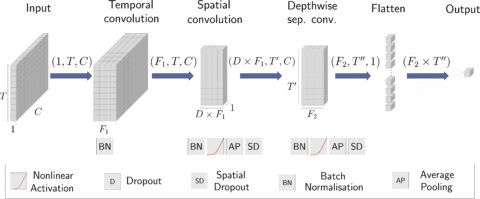
Cochlear implants are amazing neurotechnological devices that can restore hearing in deaf or almost deaf people. However, they provide only a limited amount of information on the acoustic scene. As a consequence, their users experience major difficulties when trying to understand speech in lound environments such as when others talk simultaneously. If the target sound that a user would like to listen to was known, it could be selectively amplified in the cochlear implant to make it easier for the user to understand. Here we show that the focus of attention can be decoded from brain signals (EEG), and that DNNs achieve a better deocding accuray than baseline linear models.
C. Jehn, A. Kossmann, N. K. Vavatzanidis, A. Hahne, T. Reichenbach,
CNNs improve decoding of selective attention to speech in cochlear implant users,
J. Neur. Eng. 22:036034 (2025) [techRxiv][pdf]
The complete EEG data is available on zenodo.org.