
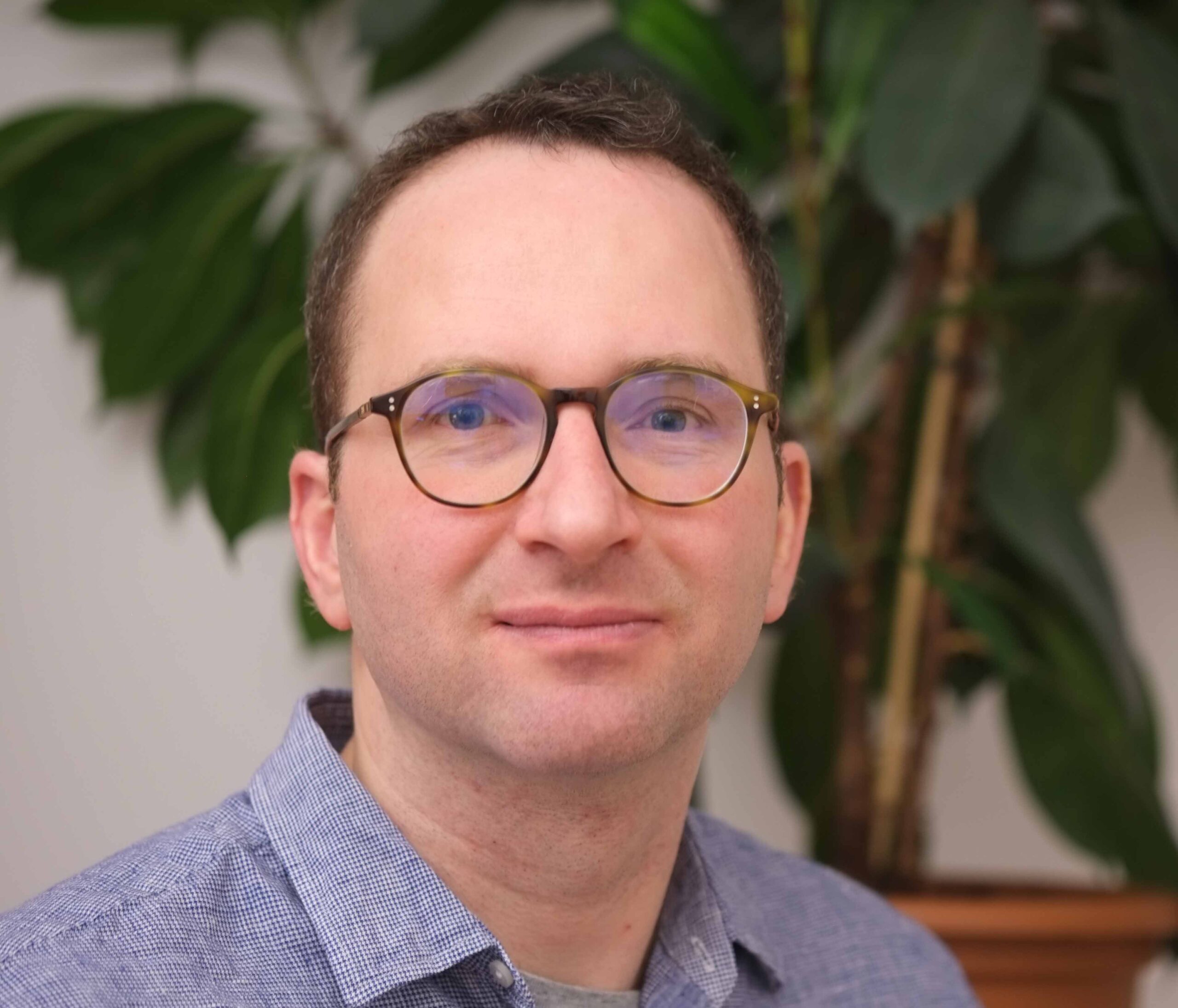
Prof. Dr. Tobias Reichenbach
Professorship for Sensory Neuroengineering
Professors
Contact
Prof. Dr. rer. nat. Tobias Reichenbach (MSc Physics, Leipzig University; PhD Physics, LMU Munich) is a Professor (W3) in Sensor Neuroengineering in the Department Artificial Intelligence in Biomedical Engineering (AIBE) at the Friedrich-Alexander-University Erlangen-Nürnberg (FAU). He is also a Visiting Professor at the Department of Bioengineering at Imperial College London. Before joining FAU, he gained postdoctoral experience at the Rockefeller University in New York, and subsequently worked as a Lecturer, Senior Lecturer and Reader at the Department of Bioengineering at Imperial College London.
Tobias Reichenbach's multidisciplinary research combines methods from artificial intelligence with computational neuroscience and neuroimaging to advance our understanding of the neural processing of complex natural signals, with applications in medicine and technology. He has published more than 80 peer-reviewed articles, some of which have appeared in leading multidisciplinary journals such as Nature, Neuron and PNAS. Former PhD students and postdocs from his group have obtained positions at well-known universities and research institutes such as Harvard, Oxford University, the Max-Planck Institute in Nijmegen and Maastricht University.
- C. Jehn, A. Kossmann, N. K. Vavatzanidis, A. Hahne, T. Reichenbach,
CNNs improve decoding of selective attention to speech in cochlear implant users,
J. Neur. Eng. 22:036034 (2025) - A. Schüller, A. Schilling, P. Krauss, S. Rampp, T. Reichenbach,
Attentional modulation of the cortical contribution to the frequency-following response evoked by continuous speech,
J. Neurosci. 43:7429 (2024) [bioRxiv][pdf] - M. Thornton, D. Mandic, T. Reichenbach,
Robust decoding of the speech envelope from EEG recordings through deep neural networks,
J. Neur. Eng. (2022) 19:046007. [pdf] - P. Guilleminot, T. Reichenbach,
Enhancement of speech-in-noise comprehension through vibrotactile stimulation at the syllabic rate,
Proc. Natl. Acad. Sci. U.S.A. (2022) 119:e2117000119. [pdf] - M. Keshavarzi, E. Varano , T. Reichenbach,
Cortical tracking of a background speaker modulates the comprehension of a foreground speech signal,
J. Neurosci. 41:5093 (2021). [pdf] - H. Weissbart, K. Kandylaki, T. Reichenbach,
Cortical tracking of surprisal during continuous speech comprehension,
J. Cogn. Neurosci. 32:155 (2020). [pdf] - O. Etard and T. Reichenbach,
Neural speech tracking in the theta and in the delta frequency band differentially encode clarity and comprehension of speech in noise,
J. Neurosci. 39:5750 (2019). [pdf] - T. Reichenbach, A. J. Hudspeth,
The physics of hearing: fluid mechanics and the active process of the inner ear,
Rep. Progr. Phys. 77:7 (2014). [pdf] - T. Reichenbach, A. J. Hudspeth,
A ratchet mechanism for amplification in low-frequency mammalian hearing,
Proc. Natl. Acad. Sci. U.S.A. 107, 4973-4978 (2010). [pdf] [Animation] - T. Reichenbach, M. Mobilia, E. Frey,
Mobility promotes and jeopardizes biodiversity in rock-paper-scissors games,
Nature 448, 1046-1049 (2007). [pdf] [Movie I (9.5 MB)] [Movie II (9.5 MB)]